
M555: Ordinary Differential Equations
5.7 Bessel's Equation
5.7.1 Bessel's Equation 
Here we examine a very important differential equation named after Friedrich Wilhelm Bessel,
Bessel's equation
:
$$ x^2 y'' + xy' + (x^2 - \nu^2)y = 0, $$
where $\nu$ is a constant. When $x=0$, we have a regular singular point, since
$$ p_0 = \lim_{x\rightarrow 0} x\dfrac{Q(x)}{P(x)} = \lim_{x\rightarrow 0} x\dfrac{x}{x^2} = 1, $$
and
$$ q_0 = \lim_{x\rightarrow 0} x^2\dfrac{R(x)}{P(x)} = \lim_{x\rightarrow 0} x^2\dfrac{x^2-\nu^2}{x^2} = -\nu^2. $$
From here, we invoke
Theorem 5.6.1
to get the indicial equation an find the values for $r$
$$ \begin{aligned}
r(r-1) + p_0 r + q_0 &= 0 \\
r(r-1) + r - \nu^2 &= 0 \\
r &= \pm\nu.
\end{aligned} $$
Clearly, the solution to the ODE changes based on the value of $\nu$. This value will be referred to as the
order
of the equation and the solutions are called
Bessel functions of order
$\nu$. We will look at 3 cases, $\nu = 0$, $\nu = \frac{1}{2}$, and $\nu = 1$ and the solutions for when $x \gt 0$.
5.7.2 Bessel Equation of Order Zero 
For $\nu = 0$, the ODE reduces to
$$ x^2 y'' + xy' + x^2 y = 0,$$
with the indicial equation
$$ \begin{aligned}
F(r) &= r(r - 1) + p_0 r + q_0 \\
&= r(r - 1) + r + 0\\
&= r^2
\end{aligned} $$
Both roots are zero, and we may represent a solution of the ODE as
$$ y_1(x) = 1 + \sum_{n=1}^\infty a_n(0)x^n,\quad x\gt 0 $$
where $a_n$ is given by the recurrence relation
$$ a_n (r) = \dfrac{-1}{F(r+n)}\sum_{k=0}^{n-1} a_k\Big((r+k)p_{n-k} + q_{n-k}\Big),\quad n\ge 1. $$
Note: we express the coefficients here in the form
$$ a_n(r) $$
at some points. This is because the power series does in fact depend on the value for $r$. However, it is very inconvenient (and confusing) to write this for every step in the summation notation since it looks like multiplication. Therefore, it will be omitted unless a formula is being stated.
To use the techniques of the previous section, we need to understand that the power series of functions $xp(x)$ and $x^2 q(x)$ are interpreted as
$$ x p(x) = 1 = \sum_{n=0}^\infty p_n x^n,\quad x^2 q(x) = x^2 = \sum_{n=0}^\infty q_n x^n. $$
We see that $p_0 = 1$ and $q_2 = 1$, with all other $p_n,\ q_n = 0$. The coefficient $p_0$ never shows up in the recurrence relation, so we will only need to look for where $q_2$ shows up.
Now we are ready to proceed. Setting $n=1$, we can use the recurrence relation to find
$$ \begin{aligned}
a_1(0) &= \dfrac{-1}{F(0+1)}\sum_{k=0}^{1-1} a_k\Big((0 + k)p_{1-k} + q_{1-k}\Big) \\
\\
&=\dfrac{-1}{F(0+1)} a_0\Big((0)p_{1} + q_{1}\Big) \\
\\
&= -\dfrac{a_0}{(0+1)^2} \cdot 0 \\
\\
&= 0
\end{aligned} $$
Setting $n=2$,
$$ \begin{aligned}
a_2(0) &= \dfrac{-1}{F(2)}\sum_{k=0}^{1} a_k\Big((k)p_{2-k} + q_{2-k}\Big) \\
\\
&= \dfrac{-1}{2^2} \Big( a_0\left(0\cdot p_2 + q_2\right) + a_1\left(1\cdot p_1 + q_1\right)\Big) \\
\\
&= \dfrac{-1}{4} \Big( a_0\left(0\cdot 0 + 1\right) + 0\cdot\left(1\cdot 0 + 0\right)\Big) \\
\\
&= -\dfrac{a_0}{4}
\end{aligned} $$
We can continue to use this formula to compute the $a_n$ terms, but we can shortcut the computations by looking at the general case
$$ \begin{aligned}
a_n(r) &= \dfrac{-1}{F(r+n)}\sum_{k=0}^{n-1} a_k\Big((r+k)p_{n-k} + q_{n-k}\Big) \\
\\
&= \dfrac{-1}{(r+n)^2} \Big( a_0\left((r+0)\cdot p_{n-1} + q_{n-1}\right) + \ldots + a_{n-1}\left((r+n-1)\cdot p_1 + q_1\right) \Big) \\
\\
&= \dfrac{-1}{(r+n)^2} \Big( a_{n-2}q_2 \Big) \\
\\
&= -\dfrac{a_{n-2}}{(r+n)^2},\qquad n\ge 2.
\end{aligned} $$
Using this formula, we see that since $a_1=0$, every odd indexed coefficient $a_3,\ a_5,\ldots = 0$. We can also relabel the index $n = 2m$ and look to establish a general term for the series
$$ \begin{aligned}
a_2 &= a_{2\cdot 1} = -\dfrac{a_0}{2^2} \\
\\
a_4 &= a_{2\cdot 2} = -\dfrac{a_2}{4^2} = \dfrac{a_0}{2^6} \\
\\
a_6 &= a_{2\cdot 3} = -\dfrac{a_4}{6^2} = -\dfrac{a_0}{2^6(3\cdot 2)^2} \\
&\ \ \vdots \\
a_{2m}(0) &= \dfrac{(-1)^m a_0}{2^{2m}(m!)^2},\qquad m = 1,\ 2,\ 3,\ldots\, .
\end{aligned} $$
We now have an expression for the
Bessel function of the first kind of order zero
, denoted as
$$ J_0 (x) = y_1(x) = 1 + \sum_{m=1}^\infty \dfrac{(-1)^m x^{2m}}{2^{2m}(m!)^2}. $$
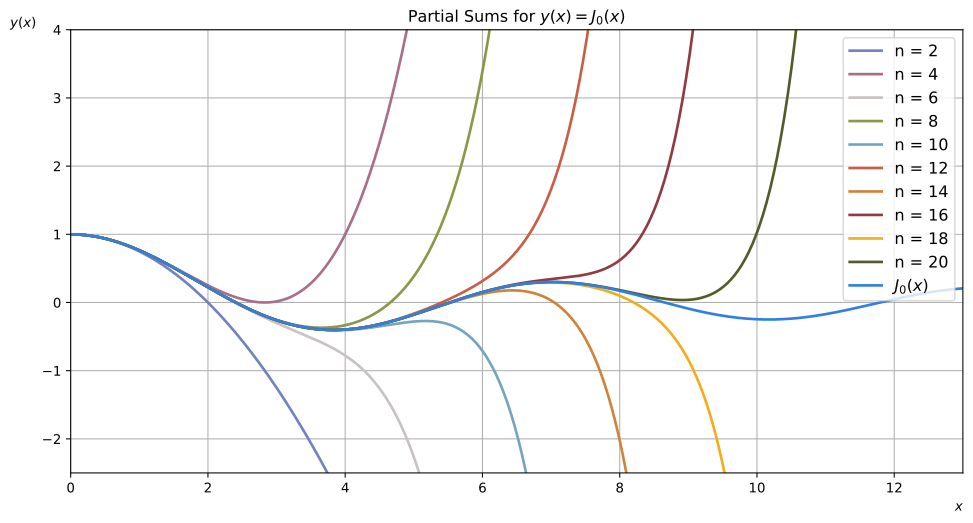
To find a second solution to form the fundamental set, we look to case 2 of Theorem 5.6.1, since both of our
exponents at the singularity
are 0. Hence,
$$ y_2(x) = y_1(x)\ln\vert x\vert + \sum_{n=1}^\infty a_n'(0)x^n. $$
To determine the values of $a_n'(0)$, we utilize the expression for $a_n(r)$, differentiate it with respect to $r$, and employ the recurrence relation. First, every odd coefficient $a_{2m-1}$ will be equal to zero. This is because our computation for $a_1(r)$ gives that
$$ a_1(r) = \dfrac{a_0}{(r+1)^2}\cdot 0, $$
which isn't just zero when $r=0$, but is zero in a neighborhood of $0$. This means that $a_1'(0) = 0$ must be zero as well. Furthermore, the recurrence relation gives that every odd $a_{2m-1}'(0) = 0$ by the same reasoning.
We now move to the even coefficients, beginning with the recurrence relation
$$ a_{2m}(r) = \dfrac{(-1)^m a_0}{(r+2)^2\ldots(r+2m)^2} = (-1)^m a_0 (r+2)^{-2}\ldots \ldots(r+2m)^{-2}. $$
To find $a_{2m}'(r)$, we take advantage of a clever trick for functions of the form
$$ f(x) = (x-\alpha_1)^{\beta_1}(x-\alpha_2)^{\beta_2}\ldots (x-\alpha_n)^{\beta_n}. $$
If $x$ is not equal to any of the $\alpha_j$ values, then the logarithmic derivative of $f(x)$ is
$$ \dfrac{f'(x)}{f(x)} = \dfrac{\beta_1}{x-\alpha_1} + \dfrac{\beta_2}{x-\alpha_2} + \ldots + \dfrac{\beta_n}{x-\alpha_n}. $$
So,
$$ \dfrac{a_{2m}'(r)}{a_{2m}(r)} = -2\left(\dfrac{1}{r+2} + \dfrac{1}{r+4} + \ldots + \dfrac{1}{r+2m}\right). $$
Which allows us to set $r = 0$ to find
$$ a_{2m}'(0) = -2\left(\dfrac{1}{2} + \dfrac{1}{4} + \ldots + \dfrac{1}{2m}\right)a_{2m}(0). $$
If we define
$$ H_m = 1 + \dfrac{1}{2} + \dfrac{1}{3} + \ldots + \dfrac{1}{m} $$
to be the $m$
-th partial sum of the harmonic series
, then
$$ a_{2m}'(0) = -H_m \dfrac{(-1)^m a_0}{2^{2m}(m!)^2}. $$
At last, this yields the formula for $y_2$:
$$ y_2(x) = J_0(x)\ln x + \sum_{m=1}^\infty \dfrac{(-1)^{m+1} H_m}{2^{2m}(m!)^2}x^{2m},\quad x \gt 0. $$
However, we are not quite finished yet. The canonical
Bessel function of the second kind of order zero
is typically written in a slightly different form, a linear combination of $J_0$ and $y_2$:
$$ Y_0(x) = \dfrac{2}{\pi}\left[ \left(\gamma + \ln\frac{x}{2}\right)J_0(x) + \sum_{m=1}^\infty \dfrac{(-1)^{m+1} H_m}{2^{2m}(m!)^2}x^{2m}\right],\quad x \gt 0, $$
where
$$\gamma = \lim_{n\rightarrow\infty} H_n - \ln n \cong 0.5772 $$
is the Euler-Mascheroni constant.
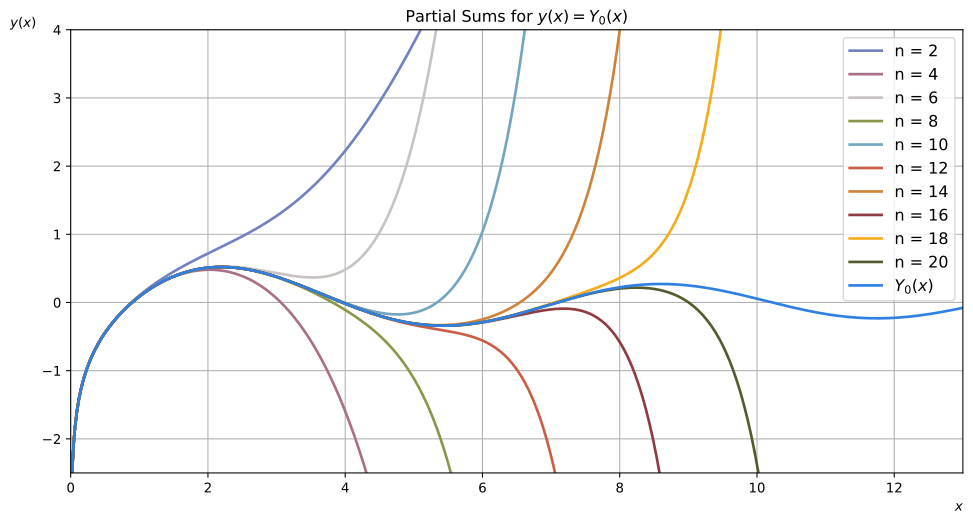
A general solution to the Bessel equation of order zero is a linear combination of these two functions
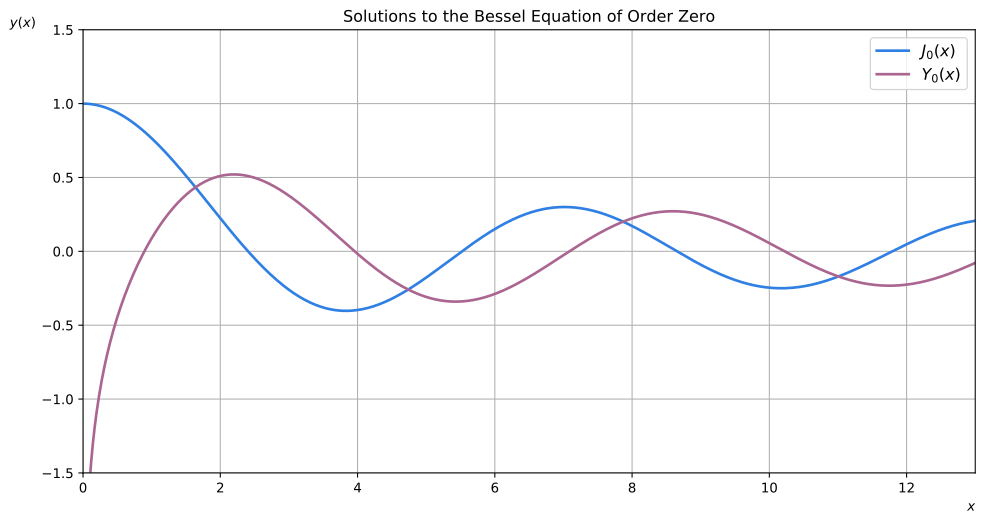
$$ y(x) = c_1 J_0 (x) + c_2 Y_0(x). $$
Here are the two functions plotted together:
5.7.3 Bessel Equation of Order One-Half 
The computations to find the Bessel functions of order one-half and one are similar to the computations for order zero. They will be included in part, showing where relevant changes have occurred.
Set $\nu = \frac{1}{2}$ in Bessel's equation
$$ x^2 y'' + xy' + \left(x^2 - \frac{1}{4}\right) y = 0,$$
then the indicial equation is
$$\begin{aligned}
F(r) &= r(r-1) + p_0 r + q_0 \\
&= r(r-1) + r - \frac{1}{4} \\
&= r^2 - \frac{1}{4}.
\end{aligned} $$
We obtain the recurrence relation using the method above, noting that for the functions $xp(x)$ and $x^2 q(x)$ that
$$ x p(x) = 1 = \sum_{n=0}^\infty p_n x^n,\quad x^2 q(x) = x^2 - \frac{1}{4} = \sum_{n=0}^\infty q_n x^n. $$
Only $p_0 = 1$, $q_0 = -\frac{1}{4}$, and $q_2 = 1$ are nonzero, and only $q_2$ will appear in the recurrence relation
$$ \begin{aligned}
a_n (r) &= \dfrac{-1}{F(r+n)}\sum_{k=0}^{n-1} a_k\Big((r+k)p_{n-k} + q_{n-k}\Big) \\
\\
&= \dfrac{-1}{(r+n)^2-\frac{1}{4}} \Big(a_0( (r)p_n + q_n) ) + a_1( (r+1)p_{n-1} + q_{n-1} ) + \ldots \\
\\
&\quad + a_{n-2}( (r + n-2 )p_2 + q_2) + a_{n-1}( (r + n - 1)p_1 + q_1 ) \Big) \\
\\
&= \dfrac{-1}{(r+n)^2-\frac{1}{4}} \cdot \Big( a_{n-2}q_n \Big) \\
\\
&= -\dfrac{a_{n-2}}{(r+n)^2-\frac{1}{4}}
\end{aligned} $$
Setting $r = \frac{1}{2}$, this expression becomes
$$ a_n\left(\frac{1}{2}\right) = -\dfrac{a_{n-2}}{n(n+1)}. $$
The value $a_0$ is arbitrary, and $a_1 = 0$ (computed directly as in the previous example). By the recurrence relation, this implies that all odd $a_{2m+1} = 0$.
For the even coefficients $a_{2m}$,
$$ a_{2m} = -\dfrac{a_{2m-2}}{2m(2m+1)},\quad m\ge 1 $$
which has an easy to compute general term
$$ a_{2m} = \dfrac{(-1)^m a_0}{(2m+1)!},\quad m\ge 1. $$
Applying our theorem and setting $a_0 = 1$, we have that the solution $y_1$ has the form
$$ y_1(x) = x^{1/2}\left(1 + \sum_{n=1}^\infty \dfrac{(-1)^m x^{2m}}{(2m+1)!} \right) = x^{-1/2}\left(\sum_{n=0}^\infty \dfrac{(-1)^m x^{2m+1}}{(2m+1)!} \right). $$
The series in this expression is the series for $\sin x$, and this allows us to define the
Bessel function of the first kind of order one-half
$$ J_{1/2}(x) = \sqrt{\dfrac{2}{\pi x}}\sin x. $$
To find the Bessel function of the second kind of order one-half, we note that the roots $\pm \frac{1}{2}$ differ by $1 = N$, a positive integer. This places us in Case 3 of Theorem 5.6.1, where
$$ y_2(x) = a J_{r_2}(x)\ln x + x^{r_2}\left(1 + \sum_{n=1}^\infty c_n\left(r_2\right) x^n\right), $$
for constants $a$ and $c_n(r_2)$ which are given by
$$ \begin{aligned}
a & = \lim_{r \rightarrow r_2} \left(r-r_2\right)a_N\left(r_2\right) \\
\\
&= \lim_{r \rightarrow -1/2} \left(r+\frac{1}{2}\right)a_1\left(-\frac{1}{2}\right) \\
\\
c_n\left(r_2\right) &= \dfrac{d}{dr}\left. \left[ \left(r-r_2\right) a_n \left(r\right) \right] \right\vert_{\ r = r_2} \\
\\
c_n\left(-\frac{1}{2}\right) &= \dfrac{d}{dr}\left. \left[ \left(r+\frac{1}{2}\right) a_n \left(r\right) \right] \right\vert_{\ r = -1/2}
\end{aligned} $$
To show that $a = 0$, we need only to show that $a_1(-1/2)$ is finite. Using the direct formula:
$$ \begin{aligned}
a_1 (r) &= \dfrac{-1}{F(r+1)}\sum_{k=0}^{1-1} a_k\Big((r+k)p_{1-k} + q_{1-k}\Big) \\
\\
&= \dfrac{-a_0}{F(r+1)} \Big( (r)p_1 + q_1 \Big) \\
\\
&= 0,
\end{aligned} $$
since $p_1 = q_1 = 0$.
We now focus on finding the values of the coefficients $c_n(r_2)$,
$$ \begin{aligned}
c_n\left(r_2\right) &= \dfrac{d}{dr}\left. \left[ \left(r-r_2\right) a_n \left(r\right) \right] \right\vert_{\ r = r_2} \\
\\
&= \left.\left[ a_n(r) + (r-r_2)a_n'(r) \right] \right\vert_{\ r = r_2}
\end{aligned} $$
We see that we are going to need the values of $a_n'(r)$ to compute them. To find those, we use the recurrence relations for $a_n$ to separate the coefficients into the even and odd sets of terms. Due to $a_1$ being zero, the odd terms are all likewise zero by the recurrence relation. Examining the even terms:
$$\begin{aligned}
a_{2m}(r) &= \dfrac{(-1)^m a_0}{\left[ (r+2)^2 - \frac{1}{4} \right]\left[ (r+4)^2 - \frac{1}{4} \right]\ldots\left[ (r+2m)^2 - \frac{1}{4} \right]} \\
\\
&= \dfrac{(-1)^m a_0}{\left[ (r+2\cdot 1)^2 - \frac{1}{4} \right]\left[ (r+2\cdot 2)^2 - \frac{1}{4} \right]\ldots\left[ (r+2m)^2 - \frac{1}{4} \right]}
\end{aligned}$$
If we look at each factor in the denominator as $(r+2k)^2 - \frac{1}{4}$ for $k = 1,\ 2\,\ldots,\ m$, it is possible to rewrite each of these as
$$ (r+2k)^2 - \frac{1}{4} = \left(r + 2k - \frac{1}{2}\right)\left(r+2k + \frac{1}{2}\right) $$
using the difference of squares. This is useful because it allows us to note that none of the roots of these quadratics will ever be $-\frac{1}{2}$ for a positive integer $k$ and sets up the logarithmic derivative trick from earlier. Hence,
$$ \dfrac{a_{2m}'(r)}{a_{2m}(r)} = -\dfrac{1}{r + \frac{3}{2}} -\dfrac{1}{r + \frac{5}{2}} -\dfrac{1}{r + \frac{7}{2}} -\dfrac{1}{r + \frac{9}{2}}- \ldots -\dfrac{1}{r + 2m - \frac{1}{2}} -\dfrac{1}{r + 2m + \frac{1}{2}}, $$
which provides an explicit formula for $a_n'(r)$. Note however, that $(r-r_2)a_n'(r)$ will be zero if $r = r_2$, since there are no factors in $a_n'(r)$'s denominator to eliminate the $r-r_2$ factor. Thus $c_n(r_2) = a_n(r_2)$.
Recalling that we set $a_0 = 1$ earlier, we have the general term
$$ c_n\left(-\frac{1}{2}\right) = \dfrac{(-1)^m }{(2m)!}. $$
Substituting this into the general form
$$ \begin{aligned}
y_2(x) &= x^{-1/2}\left(1 + \sum_{n = 1}^\infty \dfrac{(-1)^m x^{2m}}{(2m)!}\right) \\
\\
&= x^{-1/2}\cos x.
\end{aligned} $$
This is the basic form of the second solution. It is typical to choose $a_0 = \sqrt{\frac{2}{\pi}}$ to obtain the
Bessel function of the second kind of order one-half
$$ J_{-1/2}(x) = \sqrt{\dfrac{2}{\pi x}}\cos x. $$
The general solution to the Bessel equation of order one-half is
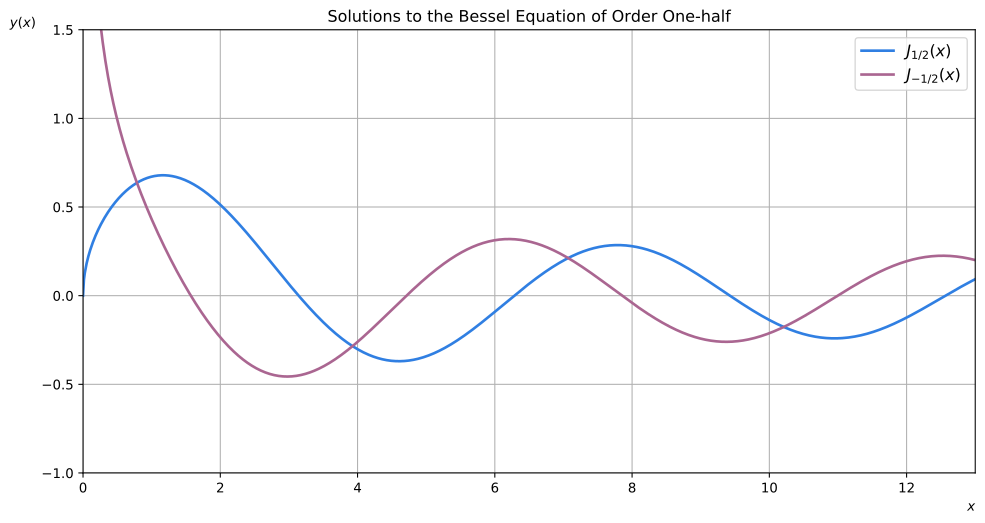
$$ y(x) = c_1 J_{1/2}(x) + c_2 J_{-1/2}(x), $$
and their plots look like:
Bessel Equation of Order One 
Under construction